When Your Cybersecurity Tools Go Blind, Do You?

Why understanding the Defensible 10 Standards matters to your cybersecurity career and practice.
Imagine arriving at work and discovering that your security monitoring platform is offline. Your security console is unavailable, and some of the tools you depend on to defend your environment may have been compromised.
What do you do next? More importantly, do you still understand the architecture you're responsible for defending?
Can you identify your critical systems, understand how they communicate, recognize trust boundaries, and determine which defensive capabilities remain available?
These are questions every cybersecurity practitioner should consider, whether you're a student preparing for your first job or an experienced professional.
Cybersecurity Is More Than Knowing Your Tools
Security tools are essential. They help us monitor, detect, investigate, and respond to threats. But tools alone do not make a defensible cybersecurity environment.
A practitioner must understand what those tools protect, where they operate, and how their capabilities fit into the larger security architecture.
When something fails, that understanding becomes even more important.
Tools support the defender. Understanding the architecture guides the defender.
Why ISAUnited Created the Defensible 10 Standards
Cybersecurity is a complex discipline. Networks, cloud infrastructure, applications, data, identities, and security operations do not function independently. They are interconnected parts of the environment we must protect.
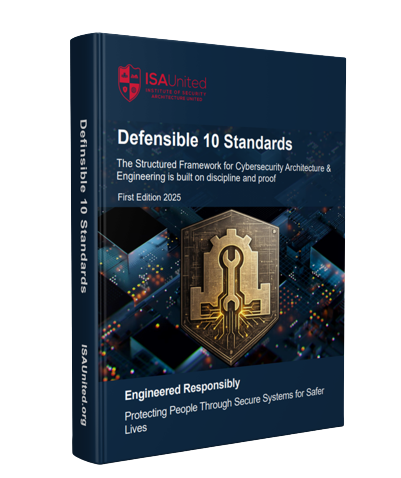
ISAUnited developed the FREE Defensible 10 Standards (D10S) to organize cybersecurity architecture and engineering into ten essential domains.
Together, these domains provide a structured foundation for understanding how cybersecurity defenses are designed, implemented, operated, and validated.
The objective is not to make every practitioner an expert in all ten domains. It is to help professionals understand how these areas connect and how their work contributes to the broader defense.
What This Means for Your Cybersecurity Career
If you're preparing for a cybersecurity job, learning the domains helps you see beyond individual technologies and certifications.
If you're already working in cybersecurity, understanding the domains strengthens your ability to investigate problems, communicate across teams, recognize dependencies, and make informed defensive decisions.
And when your primary tools become unavailable, architectural knowledge helps you determine what remains operational, where the risks exist, and how defensive work might continue.
Of course, knowledge alone cannot replace failed systems. Effective defense also requires preparation, documented procedures, alternative capabilities, and practical training.
But without understanding the architecture, even an experienced defender can lose direction.
Know Your Architecture. Understand Your Defense.
Cybersecurity defense should be structured, disciplined, and engineered rather than improvised.
Study the domains. Understand their relationships. Learn how the systems you protect are connected and how their defensive mechanisms work together.
Because knowing how to operate a security tool is one skill. Understanding the environment you're defending is another.
And that brings us back to one important question:
When your tools go blind, do you?